Ezekiel’s Symbolic Actions
"Thus Ezekiel is a sign to you; according to all that he has done you shall do; and when this comes, you shall know that I am the Lord God." — Ezekiel 24:24
The prophet Ezekiel was no ordinary messenger. God called him to live His word through dramatic symbolic actions—each one carrying meaning that words alone could not convey.
The Symbols of Judgment
Bound and Silent
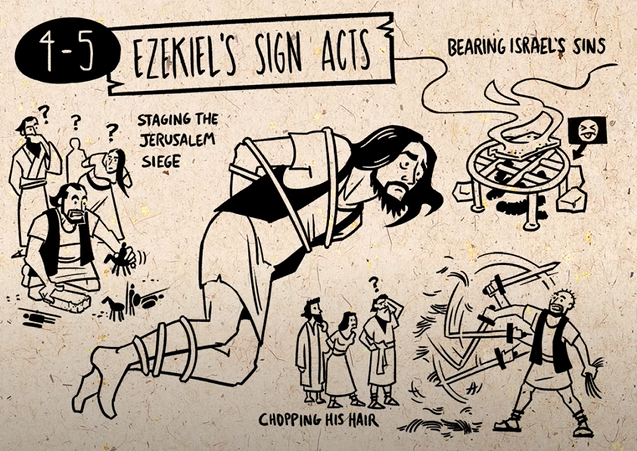
God made Ezekiel mute and bound in his own home (Ezekiel 3:23–27). This restraint symbolized a hard truth: Judah could not escape punishment, and the rebellious would not listen anyway.
Clay Tablet and Iron Plate
Ezekiel etched Jerusalem onto a clay tablet and placed an iron plate before it (Ezekiel 4:1–3)—symbolizing the barrier of judgment now standing between God and His people.
390 Days and 40 Days
He lay on his left side for 390 days, then his right for 40 (Ezekiel 4:4–8). Each day represented a year of sin—for Israel and Judah respectively. Both kingdoms would face judgment.
Bread of Scarcity
He baked bread from a strange mixture of grains and rationed his water (Ezekiel 4:9–17), eating with anxiety and drinking with dread—depicting the scarcity and terror of the coming siege.
Hair Burned, Cut, and Scattered
Ezekiel shaved his head and divided the hair into thirds (Ezekiel 5:1–4): one-third burned, one-third cut with a sword, one-third scattered to the wind. Each portion represented how Jerusalem's people would die by famine, sword, or exile.
Belongings Through the Wall
He packed his belongings and dug through his wall at dusk (Ezekiel 12:1–7), symbolizing exile. He covered his eyes, foreshadowing how King Zedekiah would be blinded before being led to Babylon.
A Death Unmourned
Perhaps the most painful act: God told Ezekiel his wife would die, and he must not mourn (Ezekiel 24:15–24). This silence carried a devastating message—when Jerusalem falls, the people will grieve their city more than their own families. The Babylonians would not just conquer; they would destroy the temple and uproot an entire culture.
A Book of Hope
Yet even in judgment, God preserved hope.
When Ezekiel divided his hair, he tucked a small portion into his garment (Ezekiel 5:3)—the remnant God would save. By all accounts, the Jewish people should have vanished like the many ancient nations that once surrounded them—the Philistines, Moabites, Amorites, Edomites, and others now lost to history. But God kept His covenant with Abraham. A remnant survived.
Later, Ezekiel joins two sticks—one for Israel, one for Judah—and they become one in his hand (Ezekiel 37:15–28), symbolizing their future reunion under one King. God destroys, but He also restores. And those in Christ become heirs to that ancient promise.
Living as Signs Today
Ezekiel's life was a sermon. His bound hands, his meager bread, his silent grief—all spoke louder than words ever could. Through his actions, God's message reached a people who refused to listen.
We are called to the same. Our lives are being watched, and our actions carry meaning.
When you show kindness to a stranger, you demonstrate what it means to love your neighbour. When you remain patient under trial, you reveal what it looks like to love your enemy. When you forgive those who wrong you, you mirror the heart of God. And when hardship strikes and you still have hope, you show the world how a citizen of heaven endures suffering.
Just as Ezekiel's trembling hands and rationed bread spoke of coming judgment, your steady hope and quiet faithfulness speak of a God who restores. Most of what we do goes unseen. But sometimes, people are watching—and your life becomes a sign.
"I will give you a new heart and put a new spirit in you; I will remove from you your heart of stone and give you a heart of flesh." — Ezekiel 36:26
Speaker: Dr. Mark Lehman